
 You can read a bit about this photo here of a Pope Hartford at The Old Motor site: http://theoldmotor.com/?p=65193 This photo is from the collection of my friend Mark Johnson, of the Klingberg Family Centers, New Britain, CT, which our local car club supports (the Valley Collector Car Club).
I’m a volunteer at the Canton Historical Museum, for my classmate from 60+ years ago, the new curator there. I wrote a proposal for them to get an assessment grant. I have an archive at University of Hartford, and expect to contribute to the CT Museum of Culture and History per the Hartford Arts Renaissance of the 1970s project that I’ve helped to create. A professionally produced book on this is forthcoming on Blurb, on The City as Stage: How a group of young artists brought Hartford, CT back to life in the 1970s.
Considerable research demonstrates the value of museums and science and nature centers for hands-on, informal, educational enrichment programs that can’t be recreated in classrooms. Today, they also represent a promising, new platform promoting critical thought, analysis, creativity, and tangible excitement about learning and teaching in the new century. But is this largely untapped? White Oak Associates Museum Planners and Producers once noted regarding the New England Auto Museum (NEAM) (I was a director there) that “A new format for changing visitor experiences is now possible given advances in museum research and practice, new audience expectations including participation, and matured digital technologies. But the innovation should bravely create a new and distinctly different kind of changing museum experience—a new presentation format combining immersion and interactivity into a new platform for STEM learning, revenue generation, and museum vitality.”
The goal is to help break the more than100-year-old process of separating technical and academic subjects, and unite the silos of science and engineering via the Next Generation Science Standards and other programs. Students not only need to be able to succeed academically to get into these promising careers but to be motivated to do so. With an artificial separation they lack motivation, or the “growth mindset” of Carol Dweck (see her book on mindset, that I used in teaching). The walls between formal and informal learning professional fields are only beginning to crumble. There is too little transfer of practice, learning, and community. Martin Storksdieck, the director of the Board on Science Education at the National Academies, suggests that advocates still have a lot of work to do in convincing policymakers and the public that informal science <and engineering and technical> learning merits increased investment.
Here are links to some research I did for the NEAM. (SpotlightonSTEMintheClassroom ) An interest in history is the gateway to other disciplines and fields of study. AA3PM_National_Report Also see Teaching History With Museums: Strategies for K-12 Social Studies, by Alan Marcus, Jeremy Stoddard, Walter Woodward. 2012.
Here is the STEM Pathways Playbook from IBM used to create P-TECH six-year schools, which are an inspiration for teaching (I was in a six-year, non-STEM, liberal arts program 1962-68). The first one was in CT, Norwalk! STEM-Pathways-Playbook_Feb-2012 See attached MDRC Study. Also see Project Lead the Way, Ford Next Generation Learning, SAE International. Some references: MDRC Study, STEM-Related_Educational_Assets_List, BeyondHS, Connecticut_hs, this CT STEM Career Partnership Grant apparently led to this CT STEM Jobs site. Also see NCREST STEM Early College Expansion Project in Bridgeport, Made in CT video at CCAT. STEM Bibliography: STEMBiblioRWalker .
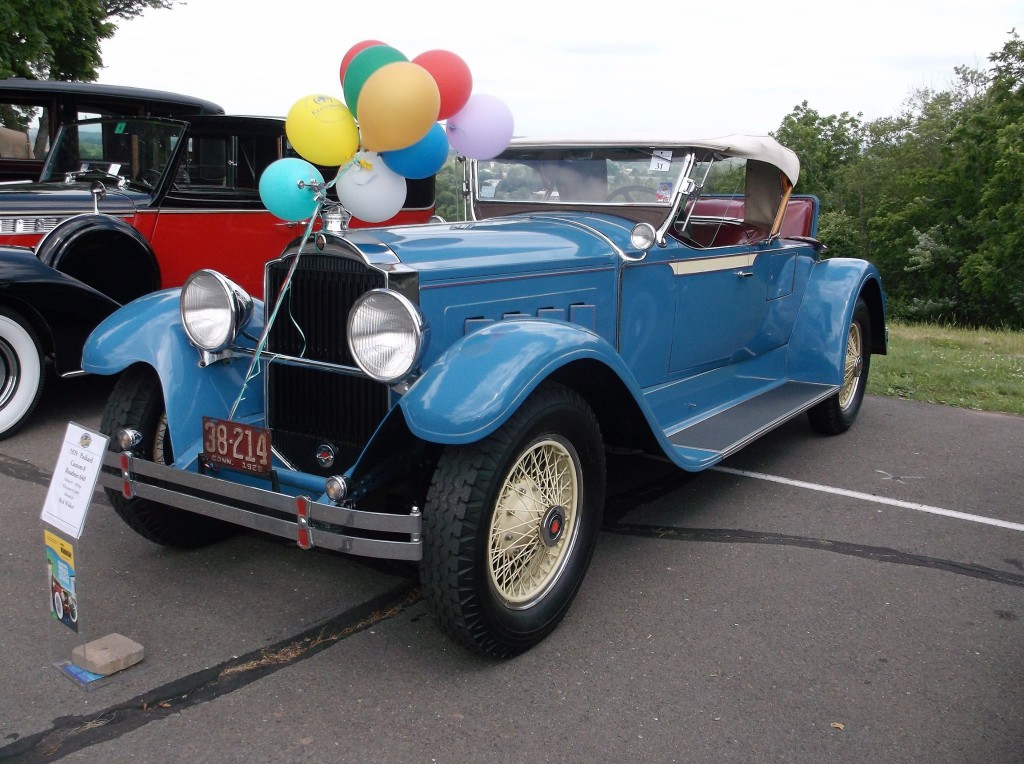
I bring 66+ years of experience in the world of auto collecting, as my father Charlie Walker was a collector and I had a few choice cars. I served as secretary of the Valley Collector Car Club that donates all profits to charities, and am still involved. For 25 years until 2021 I maintained Charlie’s primary pride and joy in the family for 65 years, this 1929 Packard Roadster 640, that won the Lou Biondi Award in 2014 at the Klingberg Family Centers annual car show, hosted by Wayne Carini and his dad. ( See F-40 Motorsports) At the Klingberg site there once was an honorable mention of Charlie. At Blurb you can buy an 80-page Klingberg Auto Show Anniversary book with the Packard on page 8 and at the end. https://www.blurb.com/books/636300-klingberg-antique-auto-show
The International Baccalaureate. Regarding the proposed school I wrote to the IB program and received this response. —The IB has four programmes, that range from ages 3-19. We do have two programmes that are geared towards the last two years. The more popular and well known one is the IB Diploma Programme which is a 2 year programme, aside from the 6 courses students would take (3 at a Standard Level and 3 at Higher Level) it also includes 3 core components, the Extended Essay (of 4,000 words), Theory of Knowledge (a philosophy course) and CAS (Creativity, Action and Service) encouraging students to engage through the arts, the community and develop a healthy lifestyle. For m ore information on the Diploma Programme here is the link – http://ibo.org/diploma/
There is also the IB Career-Related Certificate (IBCC) it currently works in tangent with the Diploma programme, so a school would first need to be authorized in the Diploma before being able to be authorized in the IBCC. The IBCC framework allows students to specialize in, and focus on, a career-related pathway leading to higher education, further education, work or apprenticeships. At the core of the IBCC there is the aproaches to learning (ATL) courses, community and service, a reflective project, and language development. For more detailed information regarding the IBCC please visit the following link Career Related IB Programme
You also had questions regarding our design technology curriculum, below are two links to the subject guide for design technology – one is the Higher Level course and the other the Standard Level
http://ibo.org/recognition/resourcesanddocumentlibrary/documents/4_DesigntechHL.pdf
http://ibo.org/recognition/resourcesanddocumentlibrary/documents/4_DesigntechSL.pdf
(Note: these links don’t seem to work anymore but here is a related link: Design Tech Blog
From MIT: We see emerging a new pedagogical paradigm for education, which cuts across various disciplines and scales, to demonstrate that “design is not a discipline” but a way of looking at the world that promotes the synthesis of interdisciplinary knowledge across scales in order to create objects and systems for the greater good. This is partly due to the fact that such challenges—such as the race to cure cancer, the mars landing mission and the challenge to design sustainable cities and buildings—require, perhaps more than ever, an interdisciplinary skill set and an ability to operate across multiple scales with creativity.
The history of design innovation provides endless examples of cross disciplinary individuals and innovations. Buckminster Fuller, for instance, was a designer, a futurist, an inventor, an author, and a systems theorist. His designs based on the geodesic dome have inspired not only generations of designers, architects, engineers, and urban planners but also chemists, material scientists, and physicists who were inspired by his representation of the physical world. Charles and Ray Eames were mid-century American designers working at a range of scales and in a variety of media, from furniture and military aircraft parts to films and exhibitions. Their experiments in design fabrication and cultural media are a useful reference for design education today. An example of the value of learning across disciplines today is found in Siddhartha Mukherjee’s book, Emperor of All Maladies: a Biography of Cancer, which tells the story of how the process of inventing cell dyes to trace the growth of cancerous tissues was actually inspired by textile design.
Design has expanded to include a broad range of scales and disciplines, shifting from the production of objects to the design of experiences, data, networks, territories, and social frameworks. Designers are no longer exclusively committed to design autonomous objects (buildings, cars, furniture and household products), but rather are conceiving and testing whole ecologies of design experiences (robotic construction systems, transportation systems, health care experiences, water distribution, and clean energy). This has prompted Tim Brown, CEO of the design consultancy firm IDEO to state, “Design is too important to be left to designers.” The scope of design ecologies is so broad and so integrated with other disciplines that traditionally trained designers are ill equipped to tackle the new breadth of design tasks at hand. Interdisciplinary teams must work together to design the systems, experiences, environments, and futures for our increasingly complex world.http://ocw.mit.edu/courses/architecture/4-110j-design-across-scales-disciplines-and-problem-contexts-spring-2013/Syllabus/
Also at MIT “STEM Concept Videos” STEM Concept Videos