
The Conundrum of Education in the Age of Distraction

There are arguably more serious problems globally today culturally, politically, and especially environmentally than ever in history that necessitate the study of epistemology or theory of knowledge, individually and collectively, and of the role of creativity and imagination.  Our epistemic crises center on culture wars and the Technopolis in the realms of free speech protection, higher education goals, climate knowledge, environmental and species protection, the power of historical records, future of democracies, and extinction itself.

My upcoming Creative Commons anthology/textbook, with a first chapter on epistemology or theory of knowledge, examines the very possibility of knowledge and reality in the midst of all of this with rampant misinformation and disinformation, echo chambers etc.  One of the clearest ways to understand critical thinking is as applied epistemology.

This carefully curated anthology is of interest and of value to students and others who want to first consider the nature of good thinking/critical thinking that is not fully explained in schools and colleges, and also begin to envision a future of possibilities in the natural world.  While designed with students in mind, this book is also inspiring for those who want to be a part of the global movement to craft a New Story of an Ecological Civilization, via their communities, in the ocean of information, for the common good.

Taking the reality of ignorance (Agnotology) into account as part of our nature, this process of discovery is a tall order for anyone because of domination,  overconsumption, waste, and narrow and exclusionary definitions of knowledge and the knowable, and the shunting aside of other important ways of knowing and being.  But the pace of change in society and the increasing dominance of the Technopolis makes this effort a necessity. This is the realm of both epistemology and ontology and the search for truth and vital belief systems to create an infosphere of hope and love, inspired by indigenous knowledge-making over thousands of years, where humans are not separated from nature.

It is the realm of higher education as a keystone for our future, and about how to encourage and build deep learning about complex systems. The following is an early first draft of one of the chapters. EducationPhilosophyWalkerBrief2

Also in Merlot: The Conundrum of Education 

Connecticut Museums and Science Centers

You can read a bit about this photo here of a Pope Hartford at The Old Motor site:    http://theoldmotor.com/?p=65193  This photo is from the collection of my friend Mark Johnson, of the Klingberg Family Centers, New Britain, CT, which our local car club supports (the Valley Collector Car Club).  
I’m a volunteer at the Canton Historical Museum, for my classmate from 60+ years ago, the new curator there. I wrote a proposal for them to get an assessment grant. I have an archive at University of Hartford, and expect to contribute to the CT Museum of Culture and History per the Hartford Arts Renaissance of the 1970s project that I’ve helped to create.  A professionally produced book on this is forthcoming on Blurb, on The City as Stage: How a group of young artists brought Hartford, CT back to life in the 1970s.

Considerable research demonstrates the value of museums and science and nature centers for hands-on, informal, educational enrichment programs that can’t be recreated in classrooms. Today, they also represent a promising, new platform promoting critical thought, analysis, creativity, and tangible excitement about learning and teaching in the new century.  But is this largely untapped?  White Oak Associates Museum Planners and Producers once noted regarding the New England Auto Museum (NEAM) (I was a director there) that  “A new format for changing visitor experiences is now possible given advances in museum research and practice, new audience expectations including participation, and matured digital technologies. But the innovation should bravely create a new and distinctly different kind of changing museum experience—a new presentation format combining immersion and interactivity into a new platform for STEM learning, revenue generation, and museum vitality.”

The goal is to help break the more than100-year-old process of separating technical and academic subjects, and unite the silos of science and engineering via the Next Generation Science Standards and other programs. Students not only need to be able to succeed academically to get into these promising careers but to be motivated to do so. With an artificial separation they lack motivation, or the “growth mindset” of Carol Dweck (see her book on mindset, that I used in teaching).  The walls between formal and informal learning professional fields are only beginning to crumble. There is too little transfer of practice, learning, and community. Martin Storksdieck, the director of the Board on Science Education at the National Academies, suggests that advocates still have a lot of work to do in convincing policymakers and the public that informal science <and engineering and technical> learning merits increased investment.

Here are links to some research I did for the NEAM. (SpotlightonSTEMintheClassroom ) An interest in history is the gateway to other disciplines and fields of study. AA3PM_National_Report  Also see Teaching History With Museums: Strategies for K-12 Social Studies, by Alan Marcus, Jeremy Stoddard, Walter Woodward. 2012.

Here is the STEM Pathways Playbook from IBM used to create P-TECH six-year schools, which are an inspiration for teaching (I was in a six-year, non-STEM, liberal arts program 1962-68).  The first one was in CT, Norwalk!  STEM-Pathways-Playbook_Feb-2012    See attached  MDRC Study.  Also see Project Lead the Way, Ford Next Generation Learning, SAE International.     Some references: MDRC Study,  STEM-Related_Educational_Assets_ListBeyondHSConnecticut_hs, this  CT STEM Career Partnership Grant apparently led to this CT STEM Jobs site.    Also see  NCREST STEM Early College Expansion Project in Bridgeport,  Made in CT video at CCAT.  STEM BibliographySTEMBiblioRWalker .

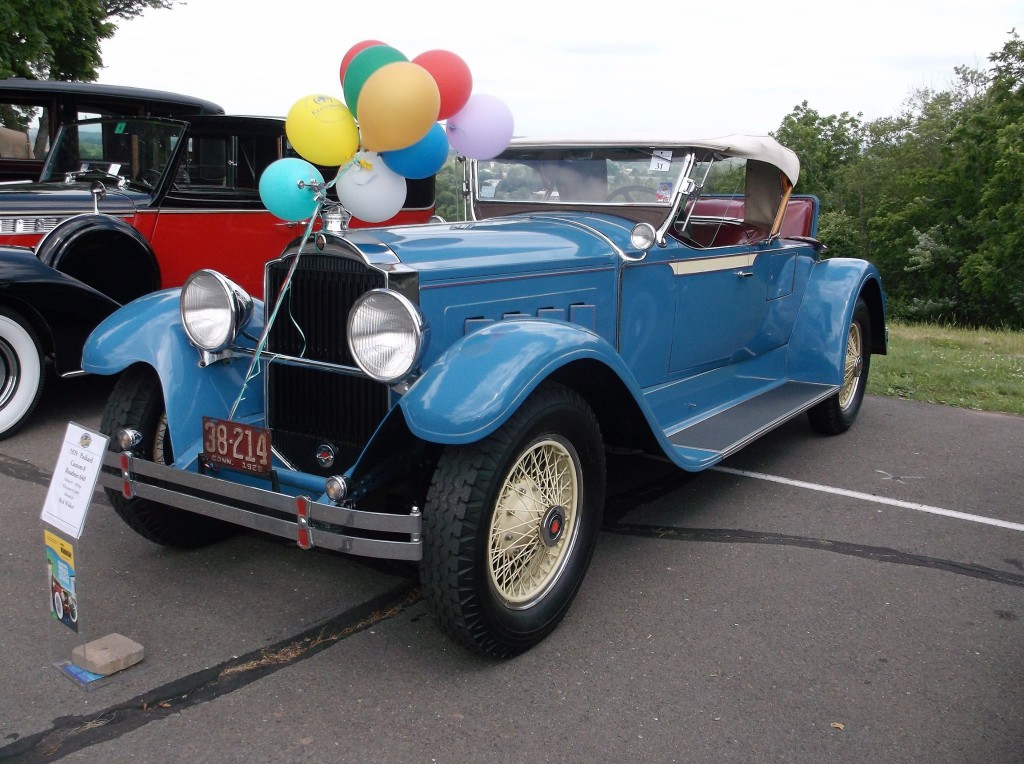
I bring 66+ years of experience in the world of auto collecting, as my father Charlie Walker was a collector and I had a few choice cars.   I served as secretary of the Valley Collector Car Club that donates all profits to charities, and am still involved.  For 25 years until 2021 I maintained Charlie’s primary pride and joy in the family for 65 years, this 1929 Packard Roadster 640, that won the Lou Biondi Award in 2014 at the Klingberg Family Centers annual car show, hosted by Wayne Carini and his dad. ( See F-40 Motorsports) At the Klingberg site there once was an honorable mention of Charlie.  At Blurb you  can download a free, 80-page Klingberg Auto Show Anniversary ebook with this auto on page 8 and at the end. https://www.blurb.com/books/636300-klingberg-antique-auto-show